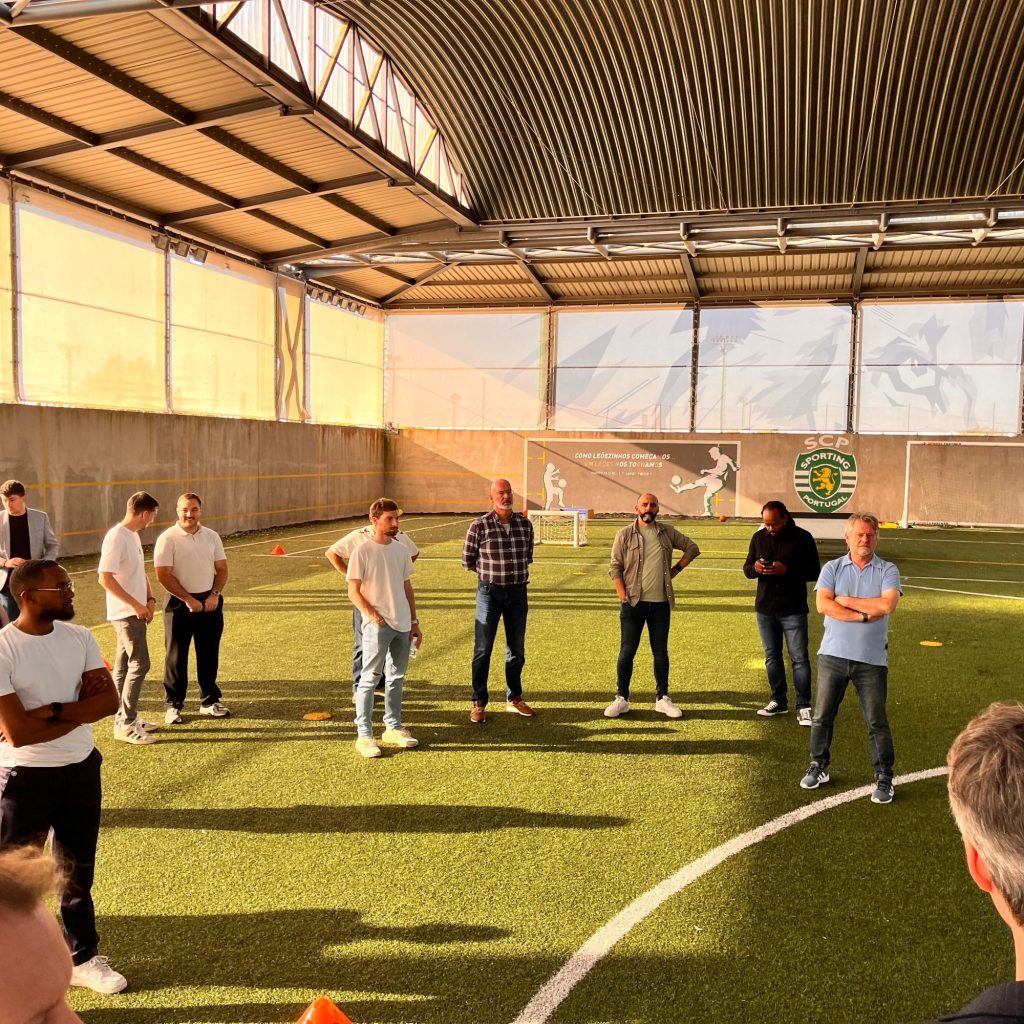
ESSMA’s Yari Van Minsel (responsible for research & data analysis) joined the group, gaining valuable insights into how these Portuguese clubs manage their infrastructure, talent identification, education, and long-term player pathways – while balancing high-level performance with sustainability and community values.
1. Benfica Campus – Turning Youth into Profit and Pride
At Benfica Campus, participants discovered what is often called the world’s most profitable academy. Benfica’s youth system has produced over €800 million in transfer value in just 19 years, nurturing players such as Bernardo Silva, João Félix, Rúben Dias, and Renato Sanches.
Benfica’s secret lies in a comprehensive ecosystem: 600 youth players, 400 staff, and a data-driven methodology covering scouting, education, and welfare. With 80 players living full-time on campus, the club ensures holistic development — emphasising schooling, psychological support, and performance tracking.
“Our mission is to prepare players for the first team, but also to educate good people,” shared the academy director. “Success isn’t only measured in transfers, but in employment and lifelong skills.”
2. Sporting CP Academy – A Legacy of Excellence and Continuous Growth
Sporting CP, famed for developing Cristiano Ronaldo and Luís Figo showcased its player-centred model, where pedagogy, tactical identity, and technical mastery combine to nurture complete footballers.
The club’s philosophy centres on “the player as the core of the ecosystem”, with a strong balance between education, well-being, and competitive excellence. Sporting emphasises long-term progression rather than short-term results – a principle deeply embedded in its coaching and scouting structures.
3. SC Braga – A Fully Integrated Sports City
At SC Braga, the group witnessed a remarkable example of centralised infrastructure. Built in 2017 and expanded in phases, Braga’s Sports City unites all teams – men’s, women’s, youth, and even basketball and futsal – on a single site.
With 2,000 athletes training weekly across 11 pitches (including hybrid and artificial surfaces), Braga’s “everything connected” model saves time, enhances communication, and fosters club identity. The club aims to add new pitches and player residences in the coming years to meet rising demand.
“Our advantage is centralisation — everything happens here,” explained Sporting Clube de Braga’s facilities manager Antonio Malheiro. “Players can walk from the academy to the stadium in ten minutes.”
4. FC Porto – Sustainable Growth and Infrastructure Renewal
At FC Porto’s training centre, the focus was on the correlation between club growth and infrastructure evolution. The club is currently developing a new training facility for its first team in Gaia, while the current complex will be renovated for youth and women’s football.
Porto’s approach is firmly guided by sustainability and efficiency — reducing water and energy consumption and integrating smart mobility between sites. The club also takes pride in its environmental certification.
“Infrastructure must evolve with ambition,” Ricardo Carvalho, Sports Facilities & Asset Manager at FC Porto, noted. “We don’t aim to build the most expensive training centre, but the smartest and most sustainable one.”
5. Shared Philosophy – Investing in People Before Players
Across all four clubs, one message stood out clearly: human development is the foundation of performance.
From Benfica’s education-first policy to Porto’s sustainable operations and Braga’s community-driven design, each club demonstrated that world-class facilities are most effective when they serve a clear purpose — to help young people grow both on and off the pitch.
The LFP delegation returned home with valuable insights to inspire the ongoing evolution of training centres in France.
ESSMA extends its gratitude to the LFP for the invitation, and to the hosting clubs – SL Benfica, Sporting CP, FC Porto and SC Braga – for their warm welcome and openness in sharing their expertise.