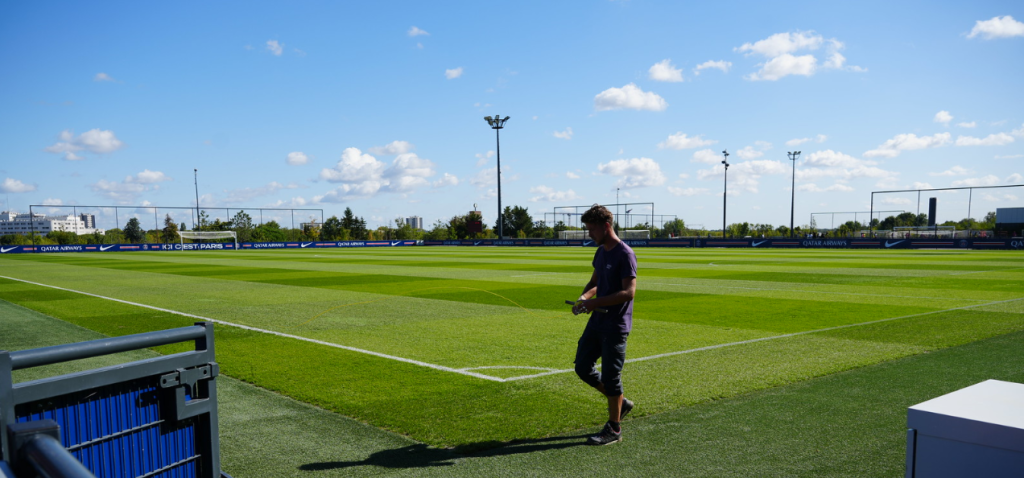
Consistency at the Core of PSG’s Grounds Strategy
Jonathan Calderwood, PSG’s Head Grounds Manager, underlined the importance of consistency. His team of 40 manages 18 pitches, including 13 natural grass and 5 synthetic, all designed to replicate the conditions of the Parc des Princes. This uniformity ensures that players experience the same playing conditions across academy, training, and stadium environments. Calderwood noted that this upfront investment in pitch construction avoids the need for incremental upgrades and guarantees high standards from the outset.
Sustainability in Practice
Environmental sustainability is embedded in PSG’s pitch management strategy. The grounds team has replaced traditional machinery with electric alternatives, from mowers to golf carts, reducing emissions. Rainwater collection and recycling systems reduce dependence on mains water during summer months, while data-driven irrigation and fertilisation ensure that only the necessary resources are applied. This not only reduces waste but also lowers operational costs while maintaining elite playing conditions.

A Global Perspective on Turf Challenges
David Roberts, Director of ISTMA, placed these practices in a global context. Over his 40-year career, Roberts has managed or advised on pitches in diverse environments, from Southampton and Liverpool to Marseille and Kazakhstan. He explained how extreme climates, limited sunlight in towering stadiums, and temporary surfaces for international tournaments all create unique challenges. Innovation is therefore critical, whether through undersoil heating that accelerates pitch recovery or volcanic zeolite that reduces fertiliser needs by two-thirds.
Raising Recognition for Turf Professionals
Beyond the technical dimension, Roberts highlighted a cultural challenge: grounds staff are too often perceived as ‘gardeners’ rather than highly skilled professionals. This lack of recognition limits investment and restricts career development. Through ISTMA, Roberts advocates for global cooperation, knowledge-sharing, and the development of tailored training programmes to raise the profile of the profession and ensure its long-term sustainability.
Synergies Between Local Precision and Global Knowledge
Taken together, Calderwood’s insights at PSG and Roberts’ international perspective underline a key message: delivering world-class pitches requires both local precision and global collaboration. Innovation in sustainability, governance, and professional recognition are not just optional extras, but necessities for the future of the sport.
Key Takeaways
• Consistency across training and stadium pitches is achieved through upfront investment and meticulous planning.
• Sustainable practices – from electric machinery and fertilisers to water recycling – are becoming industry standards.
• International collaboration and recognition of grounds staff are key to the future of turf management.