Bologna and Webuild embark on the revamp of the Dall’Ara Stadium
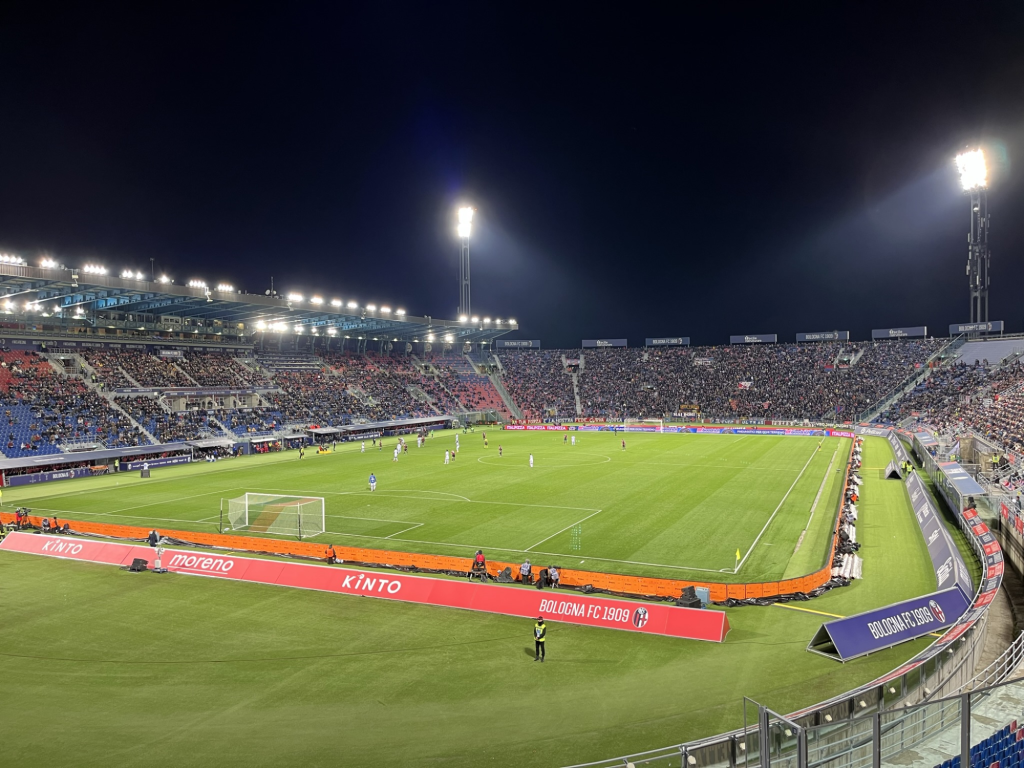
Serie A club Bologna FC has chosen Italian construction giant Webuild to lead the redevelopment of its historic Stadio Renato Dall’Ara, targeting a fresh new chapter for the stadium by the 2032 UEFA European Championship. This partnership, part of an innovative public-private collaboration with the Municipality of Bologna, grants Webuild exclusive rights to engineering, procurement and construction for the stadium’s transformation through 31 December 2027.
The ambitious €200m redevelopment project aims to transform Stadio Renato Dall’Ara into a vibrant, year-round venue with state-of-the-art features and immersive fan experiences. The overhaul will include demolishing and rebuilding all spectator stands, constructing them closer to the pitch, from the current 18 meters to just 7.5 meters, to create a more intimate atmosphere. The design also calls for a polycarbonate, shell-shaped roof that will allow natural light and air to pass through while unveiling the stadium’s original brick arcades by removing metal structures added for the 1990 FIFA World Cup. Upon completion, the upgraded Dall’Ara will host over 30,000 fans, with a more compact layout creating approximately 3.5 hectares of space for new amenities, including a Bologna FC museum. The stadium will also meet UEFA Category 4 standards, aligning with EURO 2032 hosting requirements and ensuring it can serve as a prime venue for international events.
During the construction phase, Bologna FC will temporarily relocate to a specially designed stadium with a 16,000-seat capacity, expected to be operational for the 2025-26 and 2026-27 seasons. The team is scheduled to return to the new Dall’Ara for the 2027-28 season, marking a significant.
Tottenham and Paramount Pictures launch innovative AR experience
Tottenham Hotspur has teamed up with Paramount Pictures to unveil a groundbreaking augmented reality (AR) experience at Tottenham Hotspur Stadium, coinciding with the release of Gladiator II on 15 November. This unique initiative kicked off during the club’s EFL Cup match against Manchester City on 30 October and will be available until the Premier League game against Chelsea on 8 December. Fans can access the AR experience via Snapchat, both inside and outside the stadium. Tottenham claims this is a global first, utilising GPS, world tracking and advanced 3D computer vision to transport users into the Gladiator II universe. The experience features a life-sized reproduction of the Colosseum, animated 3D Roman centurions, and a special selfie opportunity that allows fans to dress as Roman Emperors through Snapchat’s head, body and gesture tracking capabilities.
The experience also integrates distinctive elements that reflect the club’s identity. The mottos “Audere Est Facere” and “To Dare is To Do” are displayed on the walls of the Colosseum, while centurions holding Spurs-branded shields greet fans outside the stadium. A gladiator gate honours Spurs legends Son Heung-min and Ledley King with commemorative plaques and statues depict Spurs players in celebratory poses.
AC Milan and Inter Milan report record revenues
AC Milan and Inter Milan have reported impressive financial results for the 2023-24 fiscal year, highlighting their ongoing competitiveness in Serie A and providing updates on their respective stadium projects. AC Milan achieved record revenue of €457m, representing a 13% increase from the previous year’s figure of €404.5m. The club also recorded a profit of €4.1m, marking its second consecutive year in the black, although this was a slight decline from the €6.1m profit reported in 2022-23. The growth in revenue was bolstered by an increase in sponsorship income, which rose to €90.5m and commercial revenue and royalties, which generated €52.9m, largely due to the sale of premium seats at the iconic San Siro stadium. Notably, AC Milan’s robust financial performance occurred despite a decline in revenue from audiovisual rights and ticket sales, as the club did not advance as far in the UEFA Champions League this season compared to the previous one.
In contrast, Inter Milan posted a loss of €36m for the 2023-24 financial year, but celebrated record turnover of €473m, an increase of €48m year-on-year. This loss is significantly lower than the €85m deficit reported in the 2022-23 fiscal year. Inter attributed its improved financial standing to strong performances on the pitch, which boosted commercial revenues.
Following the release of these financial results, AC Milan Chairman Paolo Scaroni emphasised the importance of the San Donato project, stating it remains central to the club’s strategic vision. However, he expressed ongoing concern regarding plans to construct a new stadium at San Siro, citing previous unsuccessful attempts to advance such projects. Meanwhile, Inter’s Chief Executive Alessandro Antonello shared that the club is simultaneously pursuing plans for a new stadium in the San Siro area and a facility in Rozzano. Antonello mentioned that both clubs are awaiting feedback from the Revenue Agency’s report before making further decisions regarding the San Siro project. He also noted that the Rozzano option remains viable, with the club holding an exclusive contract for the land until January 2025.
St. Pauli’s vision for cooperative stadium ownership
German Bundesliga club St. Pauli has announced an ambitious initiative to establish ownership of Millerntor-Stadion through the creation of a pioneering cooperative, claimed to be the first of its kind in world football. Currently, St. Pauli owns the stadium, but the club aims to leverage the cooperative model to raise up to €30m, facilitating the purchase of a majority stake in the iconic venue. The new venture, named Football Cooperative Sankt Pauli 2024, will open its doors to a broader audience, welcoming not only fans and members but also outside investors. The subscription period for shares is set to commence on 10 November 10, with each share priced at €850, comprising €750 for the share itself, plus a €32 management fee and €68 earmarked for reserves.
St. Pauli president Oke Göttlich expressed enthusiasm for the cooperative model, stating, “The cooperative is the perfect model for FC St. Pauli. It gives members and fans a stake under a general democratic rule, everyone has one vote, irrespective of the number of shares purchased. This is the most important project for FC St. Pauli since the new build of Millerntor-Stadion. We aim to demonstrate that not only is a different kind of football possible, but also a different kind of financing.”
Cambridge United plans stadium revamp designs by December
Cambridge United has announced its intention to unveil designs for the redevelopment of Cledara Abbey Stadium by the end of the year, following a missed target for this summer. The English League One club, which has called the stadium home since 1932, provided an update on the ambitious transformation plans aimed at modernizing the venue. CEO Alex Tunbridge emphasised the club’s commitment to long-term modernisation, stating, “Cambridge United is seeking to modernise for the long term as a club and the stadium redevelopment is at the heart of that. We had hoped to set out plans in the summer, but the timetable has slipped to the end of the year.”
The redevelopment project aims to increase the stadium’s capacity and enhance facilities across the board to drive additional revenue and improve competitiveness on the pitch. The club plans to redevelop both the Habbin Stand and the Newmarket Road End, targeting an overall capacity of just under 12,000 seats. The proposed renovations include the construction of a new 3,300-seat stand for home supporters in the Habbin Stand, featuring upgraded hospitality and family facilities. Meanwhile, the Newmarket Road End will be transformed into a 3,500-seat terrace, which will be designed to accommodate safe standing options. Additional developments will include a new club shop, offices and a museum.
To support this expansion, Cambridge United has reached an agreement with the Supporters Club to build a new facility, allowing for the demolition of the existing one. This will free up space for the expanded Newmarket Road End and enable the pitch to be relocated south. The club has committed to investing €1.8m in the new Supporters Club building. Despite its advantageous location near the city centre, the tight footprint of Cledara Abbey Stadium presents certain logistical challenges for the redevelopment. In December, Cambridge United appointed Holmes Miller as the project’s architects and Wrenbridge Sport as project managers to navigate these complexities and bring the vision to fruition.
Juventus and Italian Rugby Federation Announce New Partnership Deal
Allianz Stadium is set to host its first major non-football event as part of a significant new partnership between Serie A club Juventus and the Italian Rugby Federation (FIR). The agreement ensures that elite rugby union will return to Allianz Stadium in both 2025 and 2026, establishing a three-year deal that promises to enhance the venue’s profile in the sports arena. The upcoming match against the All Blacks highlights Italy’s return to Turin, rounding out an exciting Autumn Nations Series that also features home matches on 9 November at Udine’s Stadio Friuli and on 17 November in at the Sadio Luigi Ferraris home of Genoa and Sampdoria.
GAA Reaffirms commitment to Casement Park redevelopment with scaled-back plans
The Gaelic Athletic Association (GAA) has reiterated its commitment to the redevelopment of Casement Park in Belfast, aiming for a minimum capacity of 30,000, but with a “lower specification” than originally planned. In a recent meeting with Communities Minister Gordon Lyons, GAA representatives addressed the future of this long-stalled project. In September, Casement Park was removed from the list of venues for the UK and Ireland’s UEFA Euro 2028 after the UK Government announced it would not provide funding, citing significant cost increases related to the redevelopment. The stadium, closed since 2013 and intended to be Northern Ireland’s only venue for the tournament, is set for reconstruction to accommodate approximately 30,000 spectators. However, the project has encountered numerous delays over the years, primarily due to financial constraints and planning issues.
During last week’s discussions, GAA official Burns stated that while the organisation still envisions a stadium exceeding 30,000 in capacity, the fit-out will be more “modest and basic” than what was initially envisioned for Euro 2028. The GAA is reportedly returning to its earlier vision for Casement Park, prior to its selection as a venue for the major football event. Following the meeting, Burns expressed optimism that the project remains a “priority” for Minister Lyons and the Stormont Executive, although he acknowledged that a new timeline for progress has yet to be established. Despite the challenges, Burns emphasised the importance of moving forward responsibly.